
✨ This article was AI edited. Editorial responsibility: EcologyWay.info.
Produced with AI. This article was artificially generated. Editorial responsibility: EcologyWay.info.
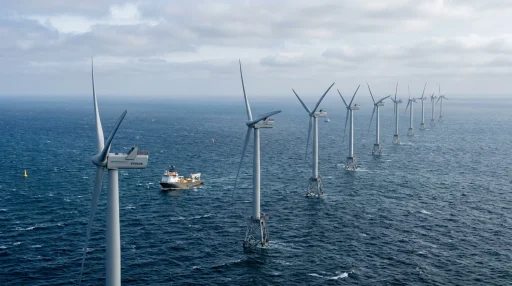
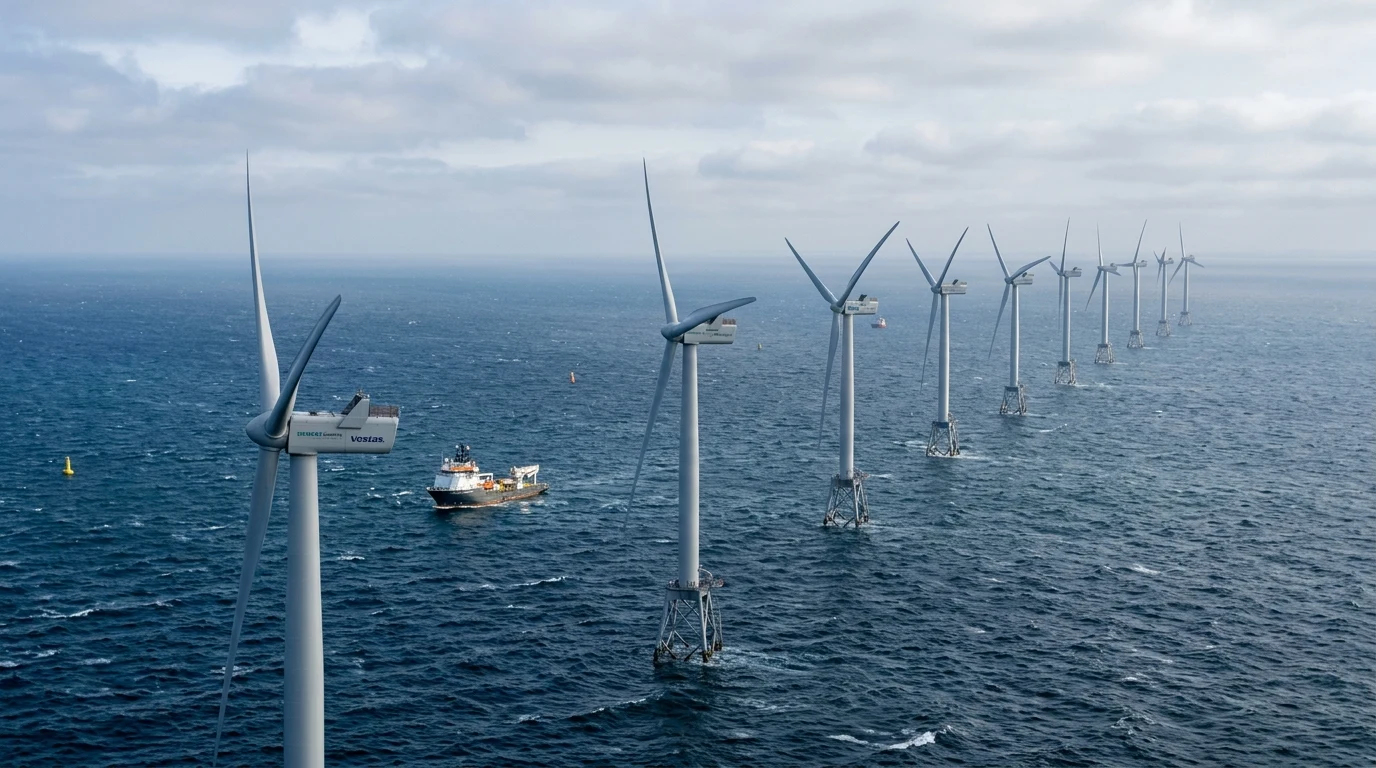
Offshore wind turbines are coated in RAL 7035 Light Grey (Lichtgrau) because this standardized industrial shade satisfies rigorous international maritime navigation guidelines (IALA O-139) and environmental impact assessments while minimizing visual intrusion. RAL 7035 provides an optimal diffuse optical reflectance that blends turbines seamlessly into overcast maritime horizons, limits solar thermal expansion in composite blade resins, and maintains critical daytime contrast for approaching shipping vessels.
Anyone viewing modern offshore wind farms across the North Sea, the Baltic, or along the Atlantic seaboard will immediately notice a universal aesthetic consistency: towering tubular steel towers, aerodynamic nacelles, and sweeping rotor blades finished in a pale, clean light grey. This color selection is neither arbitrary nor a stylistic preference of wind turbine manufacturers such as Vestas, Siemens Gamesa, or GE Vernova. Rather, it is the product of decades of collaborative engineering between maritime navigation authorities, aviation safety boards, atmospheric optical physicists, and environmental landscape planners.
The Regulatory Framework: IALA, DNV, and Aviation Harmonization
Deploying energy infrastructure into international waters requires compliance with overlapping cross-border maritime and aviation safety treaties. The primary governing standards dictating offshore wind turbine visual marking include:
- IALA Recommendation O-139: The International Association of Marine Aids to Navigation and Lighthouse Authorities (IALA) establishes global protocols for the marking of man-made offshore structures to prevent marine vessel collisions.
- DNV-ST-0437 & DNV-ST-0145: Det Norske Veritas (DNV) standards specify offshore structural reliability, material coating longevity, and visual conspicuity requirements.
- ICAO Annex 14 & FAA AC 70/7460-1M: The International Civil Aviation Organization and the US Federal Aviation Administration enforce obstacle marking regulations to ensure low-altitude aircraft safety during coastal search-and-rescue or maritime transport operations.
Under these coordinated standards, the upper superstructure of an offshore wind turbine—everything situated above the yellow maritime transition piece—must be finished in a neutral, non-reflective color with a specified daylight luminance factor. RAL 7035 was universally adopted as the international reference standard fulfilling all cross-agency parameters.
Atmospheric Optics and Maritime Horizon Blending
A primary hurdle in securing offshore wind environmental permits is visual intrusion (the perceived degradation of coastal seascapes by nearby residential and tourist communities). Overcast skies, oceanic sea fog, and maritime haze represent the predominant meteorological conditions across major offshore wind development regions.
Optical scientists measure the visual conspicuity of an object against its background using contrast attenuation formulas. Pure stark white (such as RAL 9010) creates sharp luminance contrast against grey maritime skies, drawing the human eye directly toward moving blades. Conversely, darker slate greys (such as RAL 7000 or RAL 7016) create harsh silhouette contrast under bright sunny conditions.
RAL 7035 occupies an optical sweet spot:
- Luminance Factor (Y): Approximately 55% to 60%, matching the average diffuse ambient scatter of maritime low-stratus cloud decks.
- Color Coordinates (CIELAB): L* ≈ 76.5, a* ≈ -1.2, b* ≈ 0.5. Its near-zero chroma prevents it from reflecting warm sunrise/sunset hues unnaturally.
- Atmospheric Scattering Match: Light grey Rayleigh and Mie scattering behavior allows the visual boundaries of the turbine to soften across distances exceeding 12 to 15 kilometers from shore.
Component Color Zoning: Why Transition Pieces Are Yellow
While the upper tower and blades utilize RAL 7035, the lower foundation exhibits a striking two-tone contrast mandated by maritime safety:
| Component Section | Standard Color Code | Standard Color Name | Luminance / Reflectance | Governing Authority | Primary Functional Goal |
|---|---|---|---|---|---|
| Foundation / Transition Piece | RAL 1023 | Traffic Yellow (Verkehrsgelb) | High Conspicuity (>65%) | IALA O-139 / National Coast Guards | Vessel Navigation Hazard Warning (HAT + 15m) |
| Main Tubular Tower | RAL 7035 | Light Grey (Lichtgrau) | Moderate Diffuse (~58%) | DNV-ST-0437 / Landscape Codes | Seascape Horizon Camouflage & Thermal Stability |
| Nacelle Enclosure | RAL 7035 | Light Grey (Lichtgrau) | Moderate Diffuse (~58%) | DNV / OEM Specifications | Internal Machinery Temperature Control |
| Rotor Blades | RAL 7035 | Light Grey (Lichtgrau) | Semi-Matt Non-Specular (~55%) | ICAO / FAA Obstacle Standards | Glare Prevention & Resin UV Shielding |
| Aviation Warning Markings (Tips) | RAL 3020 / RAL 2009 | Traffic Red / Traffic Orange | High Chroma Alert | National Civil Aviation Authorities | Low-Altitude Aviation Hazard Identification |
The yellow paint applied to the foundation transition piece extends from the lowest astronomical tide up to a minimum of 15 meters above Highest Astronomical Tide (HAT). This guarantees that ship radar operators and watch officers navigating in heavy fog or rough swells can clearly delineate the surface navigation barrier from small boats, while the massive kinetic structure above recedes visually into the background sky.
Thermal Dynamics and Composite Material Preservation
Beyond visual ergonomics, the thermodynamics of RAL 7035 offer significant material life benefits. Offshore wind turbine blades, which now reach lengths between 108 and 130 meters on flagship 15-megawatt machines, are fabricated from advanced epoxy resins, fiberglass fabrics, and pultruded carbon fiber composite cores.
These composite matrices are vulnerable to solar thermal degradation and micro-cracking when subjected to extreme surface temperature swings:
- Glass Transition Temperature (Tg): High-performance structural epoxy resins have a glass transition temperature typically between 70°C and 85°C. If a blade absorbs excessive infrared solar radiation, the resin approaches its Tg, leading to stiffness loss and accelerated delamination.
- Thermal Absorption Rates: Dark coatings absorb up to 85% of solar radiation, resulting in localized blade surface temperatures exceeding 65°C in direct summer sunlight. Pure black tips can reach 75°C.
- RAL 7035 Solar Reflectance Index (SRI): RAL 7035 possesses a Solar Reflectance Index above 68%, rejecting the majority of incident infrared energy. This keeps composite shell operating temperatures comfortably below 45°C even during prolonged solar exposure in calm summer doldrums.
Anti-Corrosion Chemistry: ISO 12944-9 Standards
Applying paint to an offshore wind turbine is not merely about color pigment; it requires an advanced chemical shield capable of enduring the most corrosive environment on Earth: atmospheric category CX (Extreme Marine) under ISO 12944-9 (formerly ISO 20340).
The standard multi-layer protective coating system on a steel offshore turbine tower consists of:
- Primer Coat (60–80 μm): Zinc-rich epoxy primer delivering cathodic sacrificial protection directly to the blasted steel substrate (Sa 2.5 profile).
- Intermediate Barrier Coat (150–250 μm): High-build epoxy mastic reinforced with glass flakes or micaceous iron oxide (MIO) creating a tortuous path that blocks moisture and chloride ion ingress.
- Topcoat (50–80 μm): Aliphatic acrylic polyurethane or polysiloxane formulated in RAL 7035 with semi-matt finish (gloss level 20–30 GU at 60°). This topcoat provides outstanding UV resistance, color retention, and chemical resistance against airborne marine salts.
The semi-matt finish is critical: high-gloss finishes create specular solar reflection (“blade glint”), which causes disorientation for pilots and maritime vessel bridge navigators.
Avian Protection & The Black Blade Contrast Controversy
In recent years, environmental ornithologists have investigated whether uniform RAL 7035 blades contribute to bird collisions due to “motion smear” (where rapidly rotating pale blades blur into a transparent grey disc in avian vision). A landmark study conducted at the Smøla wind facility in Norway demonstrated that painting a single rotor blade black reduced bird collisions by up to 70% by breaking motion smear.
However, implementing black blades offshore introduces complex trade-offs: increased thermal stress on blade adhesive bondlines, higher visual intrusion from shorelines, and potential conflicts with maritime aviation obstacle regulations. As a result, regulatory bodies continue to evaluate targeted contrast patterns, but RAL 7035 remains the uncontested baseline standard for overall offshore turbine architecture.
Frequently Asked Questions
What color is RAL 7035?
RAL 7035 is officially named “Light Grey” (Lichtgrau in German). It is an internationally recognized color within the RAL Classic system, characterized by a pale, neutral grey appearance with minimal chromatic undertones and a diffuse daylight luminance factor of approximately 58%.
Why are offshore wind turbines grey instead of white?
Offshore turbines use RAL 7035 light grey instead of pure white because maritime skies are predominantly cloudy, hazy, or overcast. Light grey matches the natural diffuse luminance of maritime cloud layers, significantly softening the visual impact of turbines when viewed from coastal communities, whereas bright white stands out with harsh contrast.
Why are the bottoms of offshore wind turbines painted yellow?
The foundation transition pieces are painted in high-visibility RAL 1023 Traffic Yellow up to at least 15 meters above Highest Astronomical Tide (HAT) as mandated by IALA O-139 maritime regulations. This ensures approaching vessels can clearly identify the collision hazard at sea level even in fog or turbulent ocean swells.
Does the light grey paint reduce blade glare?
Yes. Turbine coatings must comply with strict gloss-level limits (typically semi-matt, 20–30 gloss units). RAL 7035 light grey combined with a semi-matt finish prevents specular sunlight reflections known as “blade glint,” which can otherwise blind or distract aviators and ship navigators.
Get our latest guides, news, and insights highlighted in your Google Search & AI Overviews.