
✨ This article was AI edited. Editorial responsibility: EcologyWay.info.
Produced with AI. This article was artificially generated. Editorial responsibility: EcologyWay.info.
Wind direction is always described by the direction it is COMING FROM, not the direction it is blowing toward. In international meteorology, aeronautics, and wind energy engineering, a “North wind” (0°/360°) blows from the north toward the south, while a “Westerly wind” (270°) blows from the west toward the east. This distinguishes wind convention from ocean currents, which are designated by the direction they flow toward.
One of the most persistent confusions in atmospheric science, outdoor recreation, and renewable wind engineering involves determining whether a reported wind direction describes its origin or its destination. When a weather forecast or airport aviation bulletin reports an “Easterly wind,” does the air mass originate in the east, or is it traveling eastward? Understanding the universal conventions governing wind direction is essential for pilots, sailors, meteorologists, and wind turbine site operators.
The Golden Rule of Meteorology: Origin Over Destination
The established standard across all meteorological organizations—including the World Meteorological Organization (WMO), the National Weather Service (NWS), the Federal Aviation Administration (FAA), and the International Civil Aviation Organization (ICAO)—is absolute:
Wind direction is universally named for the point of the compass from which the wind originates.
To avoid ambiguity in professional reporting:
- A North Wind: Originates in the North and travels South.
- A South Wind: Originates in the South and travels North.
- An East Wind: Originates in the East and travels West.
- A West Wind: Originates in the West and travels East.
This convention contrasts directly with the terminology used for ocean currents. In oceanography, a current is named for the direction toward which the water mass moves: an “Eastward current” flows toward the east. Keeping this distinction clear is vital for maritime navigation and offshore wind energy logistics.
Instruments of Measurement: Weather Vanes, Windsocks, and Anemometers
The mechanical instruments used to measure wind direction reflect this origin-based convention directly:
1. Traditional Weather Vane (Wind Vane)
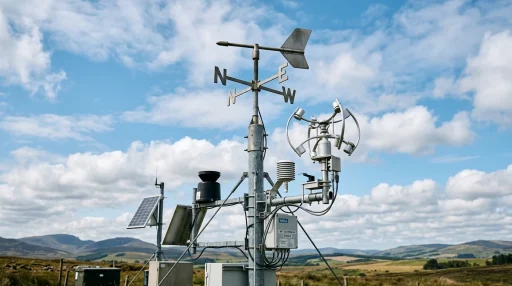
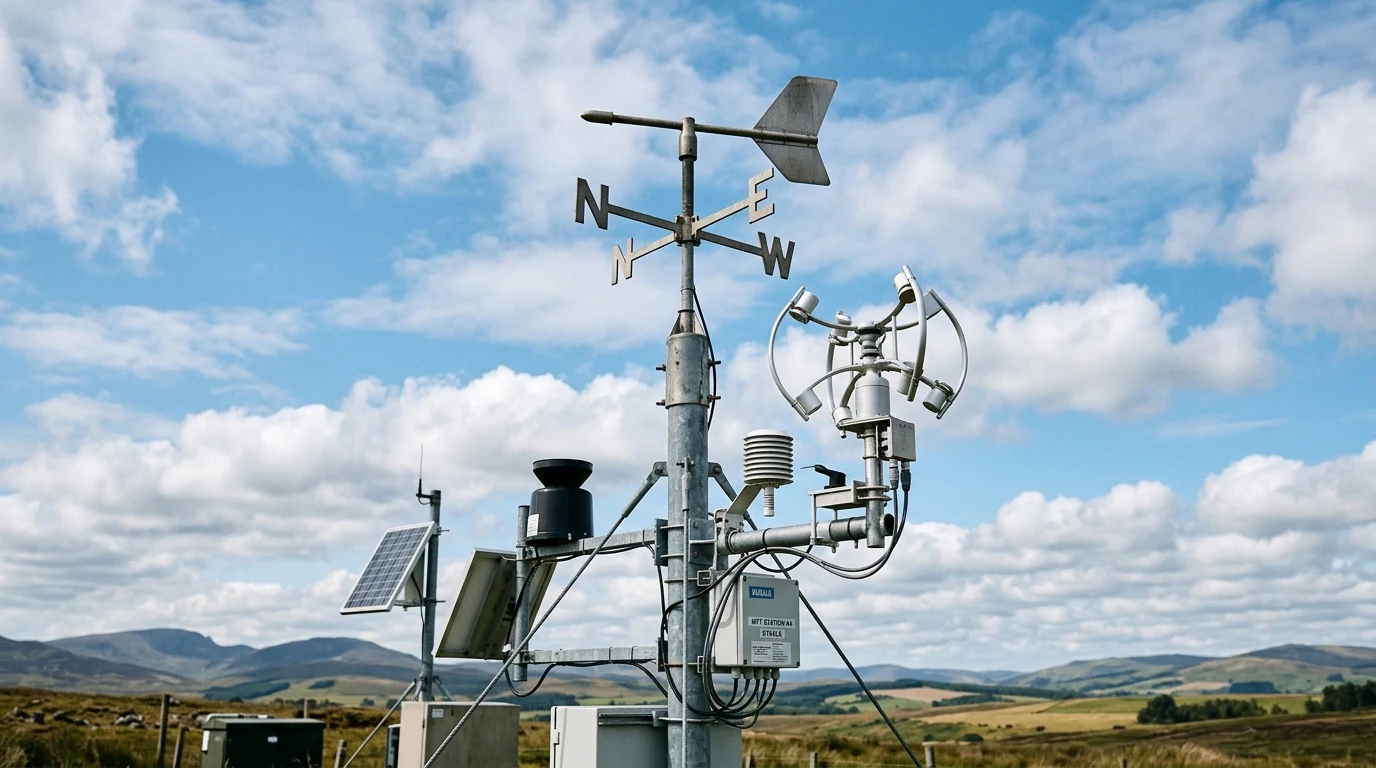
A weather vane consists of an asymmetrical aerodynamic pointer mounted on a low-friction vertical pivot. The tail fin has a larger surface area than the arrowhead pointer. When wind strikes the vane, aerodynamic drag pushes the larger tail downwind, causing the sharp pointer to turn and point directly into the oncoming wind. If the arrow points toward the West (W), the wind is a West wind, blowing from the west.
2. Airport Aviation Windsock
A windsock is a conical fabric sleeve mounted on a rotating metal collar. Air enters through the wide throat and exhausts through the narrow tail. Consequently, the cone inflates and extends downwind. Pilots look at the direction the small end of the windsock is pointing to determine the destination, and align their landing gear facing directly into the throat (landing into the wind).
3. Modern 3D Ultrasonic Anemometers
Modern weather stations and utility wind turbines utilize solid-state ultrasonic anemometers with no moving parts. Transducers transmit high-frequency acoustic pulses across calibrated paths. By calculating minute time-of-flight differences in sound transmission caused by air movement, the sensor resolves horizontal and vertical wind vectors into exact mathematical azimuthal degrees.
Compass Points vs. Azimuthal Degrees (0° to 360°)
While general public forecasts often cite cardinal directions, aviation METAR reports, maritime shipping forecasts, and wind farm SCADA systems report wind direction in exact degrees true measured clockwise from True North:
| Compass Direction | Abbreviation | Azimuthal Degree (°) | Wind Origin (Coming From) | Wind Destination (Blowing Toward) |
|---|---|---|---|---|
| North | N | 360° / 0° | Directly North | Directly South |
| North-Northeast | NNE | 022.5° | North-Northeast | South-Southwest |
| Northeast | NE | 045° | Northeast | Southwest |
| East | E | 090° | Directly East | Directly West |
| Southeast | SE | 135° | Southeast | Northwest |
| South | S | 180° | Directly South | Directly North |
| Southwest | SW | 225° | Southwest | Northeast |
| West | W | 270° | Directly West | Directly East |
| Northwest | NW | 315° | Northwest | Southeast |
Application in Wind Turbine Yaw Alignment
In modern renewable wind energy, knowing the origin of the wind is fundamental to power generation. Nearly all commercial grid-scale wind turbines are upwind machines, meaning the rotor faces into the oncoming wind in front of the supporting tower and nacelle.
When wind direction shifts:
- Nacelle anemometers register a yaw misalignment angle relative to the oncoming wind vector.
- Turbine control computers activate electric or hydraulic yaw motors, rotating the entire multi-hundred-ton nacelle atop the tower.
- The turbine rotates until the rotor axis is pointed directly into the direction the wind is coming from.
Operating with even a 5-degree yaw misalignment reduces aerodynamic power capture and introduces harmful asymmetric fatigue loads on blade root bearings.
Why Does Meteorology Use This Convention?
Historically, naming wind by its origin provided immediate qualitative weather insight. For early farmers and mariners, knowing that air originated in the Arctic North signaled freezing temperatures, while an offshore southerly breeze presaged warm, humid tropical conditions. The source of the air mass dictated its temperature, humidity, and barometric characteristics, making origin the logical descriptor.
Frequently Asked Questions
Is wind direction where the wind is coming from or going to?
Wind direction is always where the wind is coming from. For example, a “South wind” originates in the south and blows toward the north.
What direction does a weather vane point?
A weather vane points directly into the wind (toward the direction the wind is coming from). The arrow points at the source of the wind.
What does a wind of 270 degrees mean?
A wind reported at 270 degrees means the wind is coming directly from the West (270° azimuth on a 360-degree compass rose) and blowing toward the East.
Why are ocean currents named differently than winds?
Ocean currents are named for the direction they are flowing toward (e.g., an eastward current flows toward the east), whereas winds are named for where they originate. This historic distinction reflects mariners’ focus on where floating ships were being pushed versus where oncoming weather systems originated.
Get our latest guides, news, and insights highlighted in your Google Search & AI Overviews.