

✨ This article was AI edited. Editorial responsibility: EcologyWay.info.
Produced with AI. This article was artificially generated. Editorial responsibility: EcologyWay.info.
A project to install a wind turbine between building bridges involves mounting aerodynamic wind rotors on structural skybridges spanning twin or multi-tower architectural developments. This building-integrated wind energy (BIWT) concept exploits the aerodynamic Venturi effect, which naturally funnels, compresses, and accelerates prevailing ambient urban winds through the narrow chasm between high-rise structures, increasing local wind velocities by 20% to 35% before they enter the turbine swept area.
As metropolitan centers strive for on-site carbon neutrality, structural architects and renewable energy engineers increasingly investigate methods to harvest wind energy directly within urban skylines. Conventional ground-mounted wind turbines face severe obstacles in cities due to land scarcity, ground-level friction, and turbulent boundary layers created by low-rise buildings. Installing wind turbines on skybridges elevated hundreds of meters between connected skyscraper towers presents an audacious architectural and mechanical solution to urban clean power generation.
The Aerodynamic Principle: Urban Venturi Funneling
The core scientific rationale behind placing turbines between adjacent towers rests on fluid dynamics, specifically Bernoulli’s principle and the Venturi effect. In fluid dynamics, when a moving fluid (in this case, ambient atmospheric wind) encounters a constricted passage, its velocity increases as its static pressure decreases.
Skyscrapers act as massive bluff bodies redirecting high-velocity laminar airflows. When twin towers are architecturally sculpted with airfoil profiles or tapered inward toward a central gap:
- Flow Convergence: The windward facades capture oncoming wind and compress the air mass into the inter-tower corridor.
- Kinetic Amplification: Wind speed within the constricted corridor can accelerate by 1.2× to 1.35× relative to free-stream ambient velocities.
- Cubic Power Relationship: Because kinetic wind power scales with the cube of wind velocity (P = ½ρAv³), a modest 25% increase in wind speed produces an approximate 95% increase in extractable wind energy.
Global Architectural Precedents: The Bahrain World Trade Center
The definitive global benchmark for an operational project installing wind turbines between building bridges is the Bahrain World Trade Center (BWTC) in Manama, completed in 2008. Designed by engineering firm Atkins, the development features two 240-meter (787-foot) sail-shaped towers connected by three dramatic structural skybridges.
Each bridge supports a purpose-built 225-kilowatt horizontal-axis wind turbine manufactured by Norwin:
- Rotor Diameter: 29 meters (95 feet) per turbine, totaling a collective swept area of nearly 2,000 square meters.
- Annual Energy Yield: Approximately 1.1 to 1.3 gigawatt-hours (GWh) annually, providing between 11% and 15% of the twin towers’ total electrical demand.
- Aerodynamic Aerofoil Shaping: The triangular footprint of the towers acts as an aerodynamic funnel, capturing prevailing onshore shamal winds from the Persian Gulf and directing air perpendicular to the turbine blades at angles within ±45 degrees.
Key Engineering Challenges in Bridge-Mounted Turbines
While the aerodynamic benefits of bridge-mounted wind turbines are compelling, structural implementation demands sophisticated multi-physics mitigation:
| Engineering Challenge | Physical Mechanism | Structural Impact | Mitigation Strategy |
|---|---|---|---|
| Dynamic Harmonic Resonance | Blade-pass frequency (1P and 3P) coinciding with bridge natural frequency | Amplified structural fatigue, weld cracking, and anchor bolt shearing | Tuned mass dampers (TMD), variable-speed drive exclusion zones, elastomeric bridge bearings |
| Acoustic and Low-Frequency Noise | Blade aerodynamic vortex shedding and gearbox mechanical meshing | Infrasound and structure-borne vibration transmitted into adjacent office spaces | Direct-drive permanent magnet generators (no gearbox), serrated trailing blade edges, acoustic decoupling mounts |
| Differential Tower Sway | High-rise towers deflecting independently under turbulent asymmetric wind gusts | Torsional stress and longitudinal displacement across rigid bridge connections | Sliding pot bearings allowing multi-axial thermal and lateral displacement up to ±500mm |
| Urban Turbulence & Vortex Shedding | Upstream urban buildings generating localized turbulence intensities >20% | Asymmetric cyclic fatigue loading on turbine blades and pitch mechanisms | CFD micro-siting simulations, active individual pitch control (IPC), vertical-axis rotor alternatives (VAWT) |
Horizontal-Axis (HAWT) vs Vertical-Axis (VAWT) for Bridge Installations
A major design debate in building-integrated projects revolves around rotor orientation:
Horizontal-Axis Wind Turbines (HAWT)
Traditional horizontal turbines offer high aerodynamic efficiency (power coefficient Cp up to 0.45). However, in urban environments, wind direction changes rapidly and unpredictably. Traditional HAWTs require active yawing mechanisms to align with the wind. Between two fixed towers, if the wind shifts broadside (perpendicular to the gap), aerodynamic efficiency drops precipitously, and the towers can cast turbulent wake shadows onto the blades.
Vertical-Axis Wind Turbines (VAWT)
Vertical-axis machines (such as Darrieus or helical Savonius turbines) are omnidirectional, meaning they accept wind from any compass bearing without requiring a yaw motor. Furthermore, heavy drive components (generators and brakes) can be mounted at bridge floor level, lowering the center of gravity and simplifying routine maintenance. However, VAWTs historically achieve lower aerodynamic efficiency (Cp typically 0.25 to 0.35) and are prone to cyclic torque pulsations.
Project Lifecycle: Planning and Execution Roadmap
Developing a successful building-bridge wind project requires rigorous staged execution:
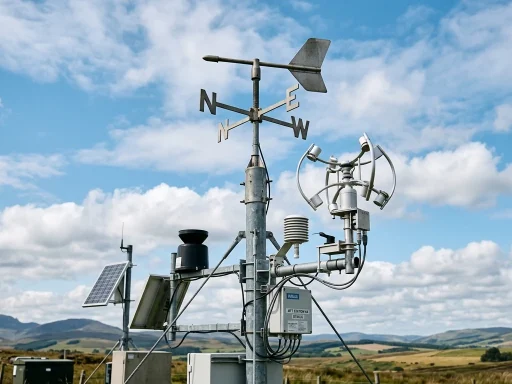
- Boundary-Layer Wind Tunnel Testing: Constructing 1:200 physical scale models in boundary-layer wind tunnels equipped with hot-wire anemometers to map localized wind velocity acceleration, shear gradients, and turbulence spectra.
- Computational Fluid Dynamics (CFD): High-resolution Large Eddy Simulation (LES) CFD modeling across 16 wind directions to evaluate wake interactions, gust turbulence, and building facade pressure distributions.
- Structural Decoupling Engineering: Designing isolated bridge substructures with high-damping rubber bearings and tuned liquid column dampers to ensure vibrational energy from rotating mechanical equipment does not propagate through floor slabs.
- Safety, Redundancy, and Maintenance Egress: Integrating internal bridge service catwalks, automated aerodynamic pitch feathering, redundant disc brakes, and certified monorail cranes capable of lowering nacelle components down to street level during overhaul cycles.
The Future: Next-Generation Building-Integrated Clean Energy
Installing wind turbines between building bridges demonstrates that urban architecture can evolve from passive energy consumers into active power-generating micro-grids. By synthesizing structural bridge engineering with advanced aerodynamic design, forward-thinking cities can capture high-altitude clean wind energy directly where energy is consumed.
Frequently Asked Questions
What building has wind turbines on bridges between towers?
The most famous example is the Bahrain World Trade Center in Manama, Bahrain. Completed in 2008, its twin 240-meter towers are linked by three structural skybridges, each housing a 225 kW wind turbine that collectively generates over 1 GWh of electricity per year.
How does the Venturi effect increase wind turbine output on buildings?
When wind enters the narrowing space between two tall buildings, it is forced through a constriction, causing the air to accelerate. Because power output increases with the cube of wind velocity, a 25% increase in wind speed almost doubles the power generation potential.
Do wind turbines on building bridges cause vibration inside the offices?
Without proper engineering, mechanical vibration and aerodynamic blade-pass frequencies can transfer into the building structure. Successful projects use elastomeric isolation pads, tuned mass dampers, and direct-drive generators to acoustically and mechanically decouple the turbines from the occupied tower floors.
Why aren’t there more building-bridge wind turbine projects?
High engineering complexity, elevated initial capital costs, structural vibration concerns, complex urban wind turbulence, and the need for specialized maintenance access have limited wide adoption compared to rooftop solar photovoltaics. However, advancements in CFD modeling and quieter vertical-axis turbines are revitalizing urban interest.
Get our latest guides, news, and insights highlighted in your Google Search & AI Overviews.