
✨ This article was AI edited. Editorial responsibility: EcologyWay.info.
Produced with AI. This article was artificially generated. Editorial responsibility: EcologyWay.info.
The 408 km/h (253.5 mph) wind gust measured on Barrow Island, Western Australia, during Tropical Cyclone Olivia on April 10, 1996, stands as the highest officially verified non-tornadic surface wind speed in Earth’s recorded history. Ratified by the World Meteorological Organization (WMO) Commission for Climatology in 2010, this extraordinary atmospheric measurement surpassed the historic 1934 Mount Washington record of 372 km/h, fundamentally altering aerodynamic engineering criteria for modern coastal infrastructure and renewable wind energy installations.
When atmospheric scientists evaluate planetary kinetic forces, surface wind velocities rarely cross the threshold where fluid aerodynamic flow transitions into pure structural destruction. While tornado funnels generate rotational winds exceeding 480 km/h in isolated vortex cores aloft, measuring such velocities at standard anemometer height (10 meters above ground level) on fixed terrestrial terrain is an exceedingly rare meteorological event. The 408 km/h gust recorded at Barrow Island represents the apex of natural non-tornadic wind phenomena, offering invaluable empirical data for meteorologists, civil engineers, and renewable energy aerodynamicists.
The Event: Tropical Cyclone Olivia and Barrow Island
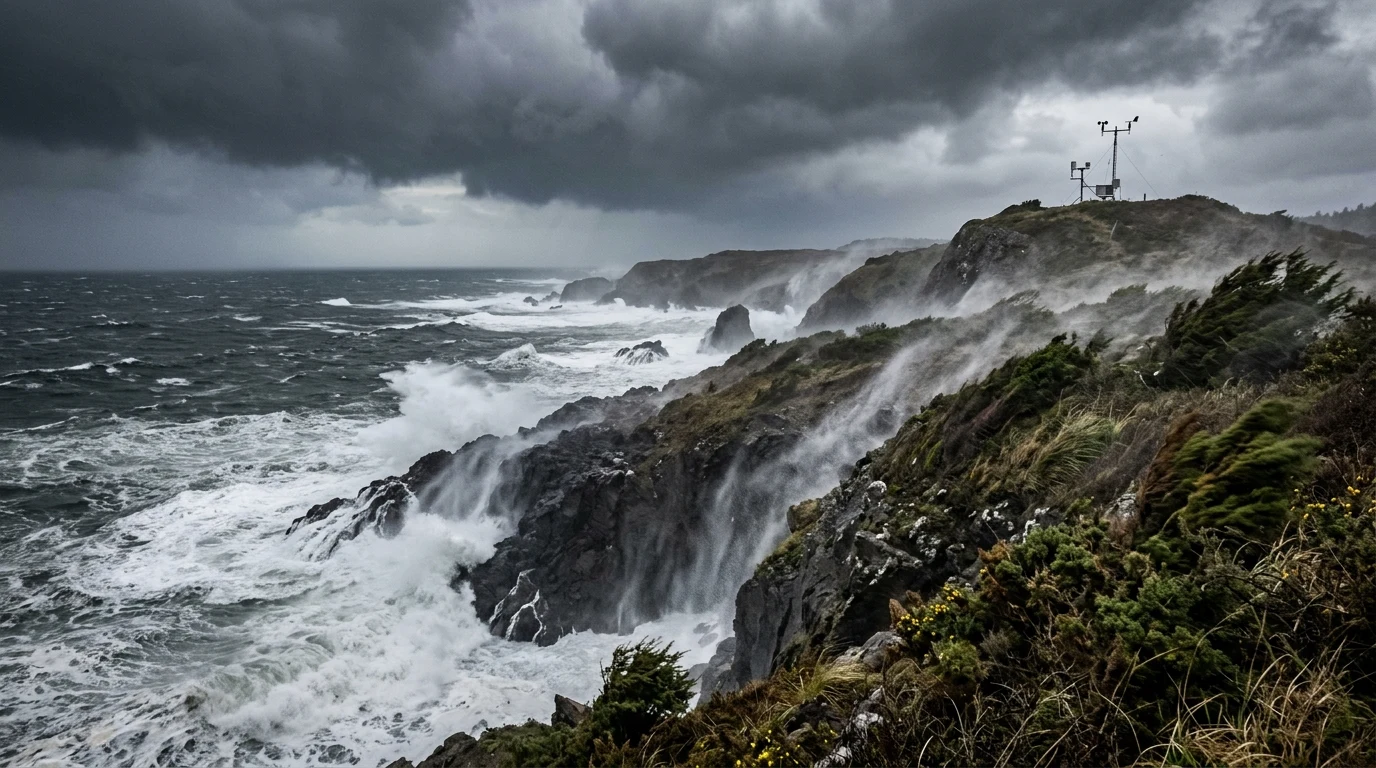
On April 10, 1996, Severe Tropical Cyclone Olivia swept across the eastern Indian Ocean toward the northwest coast of Western Australia. Barrow Island, a 202-square-kilometer island located approximately 50 kilometers (31 miles) off the Pilbara coast, found itself directly in the path of the cyclone’s dangerous southern eyewall.
Unlike transient tornadic vortices that persist for mere seconds across narrow tracks of tens of meters, Olivia was an intense, expansive synoptic system. As the eyewall traversed the island, an automated weather station operated by petroleum company Chevron recorded a sequence of extreme three-second wind gusts:
- First major peak: 369 km/h (229 mph) at 19:50 UTC
- Second major peak: 385 km/h (239 mph) at 20:00 UTC
- World record peak: 408 km/h (253.5 mph) at 20:05 UTC
- Fourth major peak: 375 km/h (233 mph) at 20:10 UTC
- Fifth major peak: 363 km/h (226 mph) at 20:15 UTC
The persistence of five distinct gusts exceeding 360 km/h within a 25-minute window demonstrated that the 408 km/h reading was not an electrical surge or transient mechanical artifact, but part of a sustained mesoscale convective downdraft supercharged by tropical cyclone boundary layer dynamics.
Anemometry & The 14-Year WMO Verification Process
Because anemometers operating under extreme maritime gale conditions are subject to electrical failure, mechanical uncalibrated over-speeding, and projectile impact, extraordinary meteorological claims undergo rigorous international forensic audits. For decades, the global gold standard for terrestrial wind speed had been the 372 km/h (231 mph) gust measured atop Mount Washington, New Hampshire, on April 12, 1934, during an intense nor’easter.
The Barrow Island station utilized a Synchrotac three-cup anemometer mounted 10 meters above sea level. Following the event, the instrument was decommissioned and transported to the Australian Bureau of Meteorology (BOM) national calibration laboratories. Rigorous wind tunnel benchmarking confirmed the instrument’s rotational linear response within ±1.5% accuracy across extreme velocity scales.
In 2009, an international panel of climate extremes experts under the World Meteorological Organization (WMO) Commission for Climatology conducted an exhaustive forensic review. The panel examined radar reflectivities, thermodynamic soundings, surrounding station barometric pressure dips (down to 925 hPa), and mechanical wear profiles of the anemometer bearings. In early 2010, the WMO formally announced that the 408 km/h gust was authentic, officially dethroning Mount Washington after 76 years as the world’s highest surface wind speed.
Comparative Analysis: Earth’s Most Extreme Surface Wind Speeds
To contextualize the magnitude of a 408 km/h gust, consider the verified meteorological records across varying atmospheric mechanisms:
| Location / Event | Date | Wind Speed (km/h) | Wind Speed (mph) | Meteorological Mechanism | WMO Status |
|---|---|---|---|---|---|
| Barrow Island, Australia | April 10, 1996 | 408 km/h | 253.5 mph | Tropical Cyclone Eyewall | Official World Record |
| Mount Washington, USA | April 12, 1934 | 372 km/h | 231.0 mph | Orographic Venturi / Synoptic Gale | Historic Record (1934–2010) |
| Bridge Creek-Moore, Oklahoma | May 3, 1999 | 486 km/h | 302.0 mph | F5 Tornado Funnel (Radar Aloft) | Doppler Radar (Non-Surface) |
| Paso Majagual, Cuba (Hurricane Gustav) | August 30, 2008 | 340 km/h | 211.0 mph | Category 4 Hurricane Eyewall | Western Hemisphere Record |
| Thule Air Base, Greenland | March 8, 1972 | 333 km/h | 207.0 mph | Arctic Katabatic Piteraq Wind | Verified Regional Record |
Aerodynamic Physics: Kinetic Force and Dynamic Pressure
The destructive capacity of wind does not scale linearly with velocity; it increases quadratically with dynamic pressure. Aerodynamic force is calculated using the fundamental equation:
q = ½ × ρ × v2
Where:
- q: Dynamic pressure in Pascals (N/m²)
- ρ (rho): Atmospheric air density at sea level (~1.225 kg/m³)
- v: Wind velocity in meters per second (m/s)
Converting 408 km/h into standard metric units yields 113.33 m/s. Substituting this into the dynamic pressure formula:
q = 0.5 × 1.225 kg/m³ × (113.33 m/s)² ≈ 7,867 Pa (7.87 kPa or 164.3 lb/ft²)
For comparison, a standard Category 1 hurricane with 120 km/h (33.3 m/s) winds generates approximately 680 Pa (14.2 lb/ft²) of dynamic pressure. The 408 km/h gust exerted more than 11.5 times the physical force of a baseline hurricane, illustrating why structures engineered only to standard building codes experience complete structural shear when subjected to peak eyewall velocities.
Impact on Offshore Wind Turbine Engineering Standards
The validation of the Barrow Island record had immediate, far-reaching consequences for the renewable energy sector, specifically the International Electrotechnical Commission (IEC) 61400 wind turbine safety standards. Prior to modern offshore expansion, turbines were predominantly certified under:
- IEC Class I: Designed for an annual average wind speed of 10 m/s and a 50-year extreme gust velocity (Vref) of 50 m/s (180 km/h).
- IEC Class T (Typhoon Class): Established for western Pacific and cyclonic waters, requiring resistance to extreme 10-minute mean winds of 57 m/s (205 km/h) and 3-second peak gusts of 79.8 m/s (287 km/h).
However, the existence of verified 113.3 m/s (408 km/h) surface gusts demonstrated that conventional Class T turbines installed in typhoon or hurricane corridors (such as the Taiwan Strait, the Gulf of Mexico, or Western Australia) could face gust envelopes well beyond their ultimate design load limits.
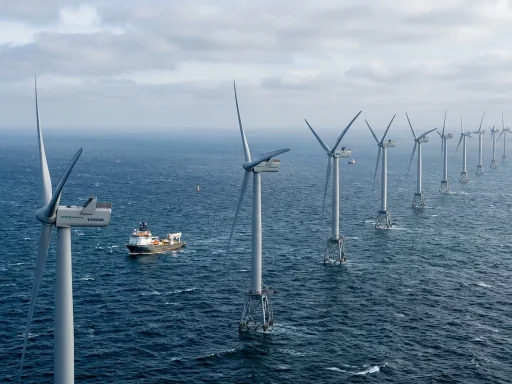
In response, leading global wind energy manufacturers—including Vestas, Siemens Gamesa, and Goldwind—engineered dedicated “Typhoon Survival Protocols” and reinforced blade geometries:
- Pitch-to-Feather Aerodynamic Lockdown: In the event of grid failure or winds exceeding cut-out thresholds (typically 25 to 30 m/s), rotor blades pitch 90 degrees parallel to the wind flow, minimizing drag coefficients from ~1.2 down to 0.08.
- Active Yaw Backup Systems: Uninterruptible power supply (UPS) battery banks and auxiliary backup diesel generators ensure yaw motors can continuously orient the nacelle directly into shifting wind directions, preventing catastrophic broadside wind loading.
- Carbon Fiber Spar Caps: Incorporating high-modulus pultruded carbon fiber composite into blade main structural spars prevents excessive flapwise deflection that could otherwise result in catastrophic blade-tower strikes during sudden 300+ km/h turbulent eddies.
Key Takeaways for Renewable Energy and Climate Resilience
The 408 km/h gust observed on Barrow Island reminds atmospheric scientists that planetary energy redistribution can produce localized kinetic spikes of monumental intensity. As oceanic thermal heat content increases due to climate shifts, the boundary layer thermodynamic efficiency of tropical cyclones continues to rise. For clean energy grids and coastal infrastructure, designing structures that anticipate extreme kinetic spikes is no longer a theoretical exercise—it is an absolute baseline for planetary resilience.
Frequently Asked Questions
What is the highest wind speed ever recorded on Earth?
The highest surface wind speed ever measured by an anemometer is 408 km/h (253.5 mph), recorded on Barrow Island, Australia, on April 10, 1996, during Tropical Cyclone Olivia. In terms of remote sensing aloft, Doppler radar measured 486 km/h (302 mph) winds inside the 1999 Bridge Creek-Moore F5 tornado funnel approximately 30 meters above the ground.
How did the WMO verify the 408 km/h wind gust?
The World Meteorological Organization conducted a detailed 14-year technical review between 1996 and 2010. Engineers recalibrated the Synchrotac three-cup anemometer in wind tunnels, evaluated atmospheric sounding data, verified surrounding pressure drops, and ruled out mechanical or electrical anomalies before granting official record status.
Can utility wind turbines survive wind gusts over 400 km/h?
Standard onshore and offshore wind turbines are designed to survive 50-year extreme gusts between 200 km/h and 288 km/h (IEC Class I and Class T). Standard turbines would likely suffer catastrophic structural failure during a 408 km/h gust unless specifically engineered under custom Class S parameters with reinforced composite carbon spars and active yawing backup systems.
What is the difference between a sustained wind and a wind gust?
Sustained wind speed represents the continuous average wind velocity measured over a standardized observation window (typically 1 minute in the United States or 10 minutes according to WMO international guidelines). A wind gust represents the brief maximum instantaneous velocity, typically measured over a 3-second moving window.
Get our latest guides, news, and insights highlighted in your Google Search & AI Overviews.